
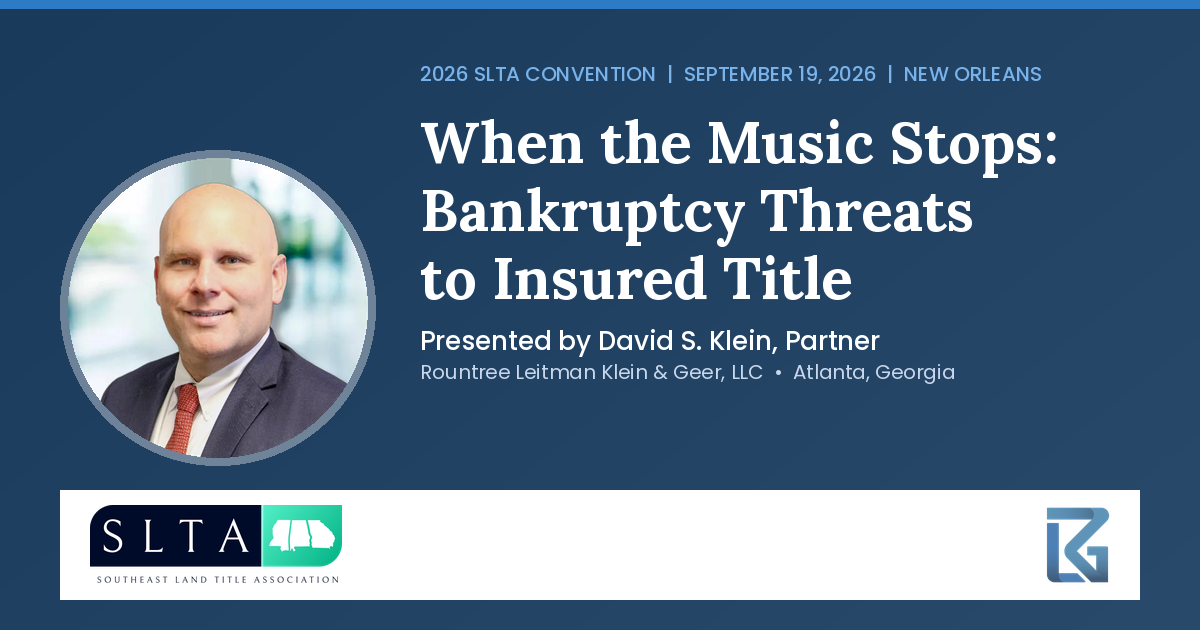
David S. Klein presented “When the Music Stops: Bankruptcy Threats to Insured Title” during the Saturday CLE/CE program at the 2026 SLTA Convention, Hotel Monteleone, New Orleans, Louisiana.
Rountree Leitman Klein & Geer, LLC is pleased to share that partner David S. Klein presented “When the Music Stops: Bankruptcy Threats to Insured Title” at the 2026 Southeast Land Title Association (SLTA) Convention on September 19, 2026. The convention, themed “Title & All That Jazz: Harmonizing Agent & Underwriter Success in NOLA,” was held September 17–19 at the historic Hotel Monteleone in the French Quarter of New Orleans and brought together title agents, underwriters, and real estate attorneys from across Mississippi, Alabama, and Georgia.
Mr. Klein’s one-hour session was part of Saturday’s “Crescent City Classes” continuing education program, appearing alongside an American Land Title Association (ALTA) update and an underwriting panel featuring representatives of several national title insurers. The presentation drew on his experience litigating quiet title actions, fraudulent transfer claims, and bankruptcy adversary proceedings in Georgia’s state and federal courts.
A Closed Deal Is Not Always a Final Deal
The presentation was built around a single premise: for a title professional, a bankruptcy filing anywhere in the chain of title is a title problem. Under 11 U.S.C. § 541, the bankruptcy estate sweeps in nearly every legal and equitable interest the debtor holds on the petition date, including causes of action. State law defines what the property interest is, but federal law decides what the estate may do with it, a division the Supreme Court set out in Butner v. United States, 440 U.S. 48 (1979). Because the trustee’s job is to collect estate property and investigate and unwind transfers, the estate is constantly looking backward at transactions the parties believed were finished.
Mr. Klein walked the audience through the principal ways the estate can reach back, organized around the life cycle of a case.
The Automatic Stay
The automatic stay under 11 U.S.C. § 362 arises the moment a petition is filed, with no notice or order required, and broadly bars acts to enforce, perfect, or continue perfection of liens against the debtor and property of the estate. A closing, deed, or security deed recorded into an open case can violate the stay, and courts divide on whether such acts are void or merely voidable. The session covered the practical consequences for underwriters: search every party in title on PACER before closing; when a case is open, condition the transaction on stay relief or an appropriate order; and, when relying on a stay-relief order to complete a foreclosure, confirm that the fourteen-day stay under Bankruptcy Rule 4001(a)(3) has run or been waived.
Mr. Klein also addressed serial filers and in rem relief under § 362(d)(4). Once an in rem order is recorded in the county land records, it binds the property for two years regardless of later filings, and the Code’s own limits in § 362(c)(3) and (c)(4) shorten or eliminate the stay for repeat debtors. For an underwriter, an in rem order of record can clear the path to foreclose even after a subsequent petition.
The Trustee’s Avoiding Powers
The heart of the presentation was the trustee’s avoiding powers, and Mr. Klein spent the most time on the one that most directly threatens a title file: the strong-arm power under 11 U.S.C. § 544(a). On the petition date the trustee stands in the shoes of a hypothetical bona fide purchaser of real property, whether or not any actual purchaser exists, and can defeat any interest that was unperfected or not properly of record. The trustee’s win comes from a recording defect, not from anything the parties intended.
In Georgia, that fight is usually about attestation. O.C.G.A. § 44-14-33 governs the attestation and acknowledgment required for a security deed to be recordable and to give constructive notice. In U.S. Bank, N.A. v. Gordon, 289 Ga. 12 (2011), and Wells Fargo Bank, N.A. v. Gordon, 292 Ga. 474 (2013), the Supreme Court of Georgia held that a facially defective attestation defeats constructive notice, allowing a trustee to avoid the deed as a hypothetical bona fide purchaser. A 2015 amendment softened that rule prospectively for instruments recorded on or after July 1, 2015, but earlier instruments in the chain remain governed by the Gordon line. Mr. Klein illustrated the point with a scenario in which a recorded but defectively attested security deed is avoided under § 544(a)(3) after the borrower files Chapter 7, the avoided lien is preserved for the estate under § 551, and the lender is left an unsecured creditor. The underwriting lesson is that a recorded instrument is not necessarily a safe one; the defect controls.
The session then turned to the remaining avoidance tools. Under § 547, a late-recorded security deed is a classic preference risk because the perfection date, rather than the signing date, usually fixes when the transfer occurred. Under § 548 and the state fraudulent transfer statutes the trustee may borrow through § 544(b), transfers for less than reasonably equivalent value can be unwound for two years under federal law and up to four years under Georgia’s Uniform Voidable Transactions Act, O.C.G.A. § 18-2-70 et seq. Because the SLTA audience spans several states, Mr. Klein noted that the borrowed statute differs by jurisdiction: Georgia, Alabama, and Arkansas apply the UVTA; Mississippi and Tennessee apply the predecessor UFTA; and Louisiana proceeds under its civil-law revocatory action. The Supreme Court’s decision in BFP v. Resolution Trust Corp., 511 U.S. 531 (1994), remains the anchor for the rule that a regularly conducted, noncollusive foreclosure sale yields reasonably equivalent value. Finally, § 549 permits the trustee to avoid unauthorized post-petition transfers, and its good-faith purchaser protection for real property is narrow: it is lost once a copy or notice of the petition is recorded in the county.
Selling and Insuring Through Bankruptcy
Not every bankruptcy is a threat to a title file; some create the transaction being insured. Mr. Klein reviewed the requirements for a sale free and clear under 11 U.S.C. § 363(f), which is available only when one of five statutory grounds is met, and urged underwriters to insist on a sale order that recites the specific ground relied upon, contains express free-and-clear findings identifying the interests released, and includes a good-faith purchaser finding under § 363(m) that can moot a later appeal of an unstayed sale. He also covered the mechanics that determine who the true grantee is: credit bidding by secured creditors under § 363(k), sales of a non-debtor co-owner’s interest under § 363(h), and the co-owner’s right of first refusal under § 363(i).
The treatment of executory contracts and unexpired leases under § 365 received similar attention. Assignment can override anti-assignment clauses in purchase and sale agreements and options, while rejection is a breach rather than a rescission, so a tenant under a rejected lease or a buyer in possession under a rejected land-sale contract may retain real rights against the property. Title professionals who handle leases and other recorded interests should not assume that rejection clears them.
Chapter-Specific Effects on Liens
Mr. Klein compared how each chapter treats liens on real property. A Chapter 13 plan may cure arrears and modify many secured claims under § 1322(b), subject to the anti-modification protection for claims secured only by the debtor’s principal residence recognized in Nobelman v. American Savings Bank, 508 U.S. 324 (1993). In the Eleventh Circuit, a wholly unsecured junior lien may be stripped off in Chapter 13 under In re Tanner, 217 F.3d 1357 (11th Cir. 2000), but Chapter 7 offers no comparable relief under Dewsnup v. Timm, 502 U.S. 410 (1992), and Bank of America, N.A. v. Caulkett, 575 U.S. 790 (2015). In Chapter 11, including Subchapter V, confirmation can vest estate property in the debtor free and clear of many interests under § 1141(c), but a plan-based transfer is not the same as a § 363 sale, and the underwriter must know which order is being insured.
Discharge, Reopening, and Unwinding
Three closing points drew particular interest from the audience. First, a discharge is not a lien release. It bars personal liability, but a valid lien rides through bankruptcy, and a recorded discharge order is neither a satisfaction nor a cancellation of a security deed. Clearing the lien still requires a release, an avoidance order, or a plan provision. Second, a closed case may be reopened under § 350(b) to administer an unadministered asset or address an omitted lien, so a recently closed case in the chain carries reopening risk. Third, dismissal under § 349(b) generally unwinds the case, revests property, and reinstates avoided transfers and liens, which means a lien “stripped” by a Chapter 13 plan can spring back if the case is dismissed before the plan is completed. The practical rule is simple: do not insure off an incomplete case.
The Underwriter’s Checklist
The presentation concluded with a working checklist for title agents and underwriters facing a bankruptcy in the chain of title:
- Search every party in title for bankruptcy, by name and taxpayer identification number, before closing.
- If a case is open, confirm stay relief or an order authorizing the transaction, and watch for an in rem order of record under § 362(d)(4).
- For a bankruptcy sale, obtain the § 363 order or confirmed plan; verify notice, finality, and the § 363(m) finding; and identify the true grantee, including any credit-bid buyer or co-owner interest.
- Scrutinize the attestation and recording of every deed and security deed in the chain, particularly instruments recorded before July 1, 2015.
- Watch the reach-back windows: 90 days and one year for preferences; two years and four years for fraudulent transfers.
- Confirm that liens have been released by an actual recorded document, not merely a discharge, and do not insure off an incomplete or dismissed case.
- Record a lis pendens wherever avoidance is threatened.
About the Southeast Land Title Association

Established in 1966, the Southeast Land Title Association serves title professionals in Mississippi, Alabama, and Georgia as a legislative advocate, an educational resource, and a forum for professional networking. Its annual convention combines continuing education for attorneys and title agents with the opportunity to exchange ideas with underwriters and colleagues from across the region. SLTA submitted the 2026 convention’s courses for continuing education credit with the State Bars of Mississippi, Alabama, and Georgia and the Alabama Department of Insurance.
About David S. Klein
David S. Klein is a partner at Rountree Leitman Klein & Geer, LLC, where he represents small businesses, corporations, and individuals in real estate and business litigation, creditors’ rights matters, and bankruptcy litigation in Georgia’s state and federal courts. His practice includes quiet title and reformation actions, real estate fraud claims, foreclosure and post-foreclosure disputes, fraudulent transfer litigation, and adversary proceedings in the United States Bankruptcy Courts for the Northern, Middle, and Southern Districts of Georgia. He served six years on the Executive Committee of the State Bar of Georgia’s Real Property Law Section, is a frequent speaker on title litigation, including at the State Bar of Georgia’s Title Standards CLE Seminar, and has been recognized by Georgia Super Lawyers as a top business and real estate litigator.
If you are a title agent, underwriter, or lender confronting a bankruptcy filing that affects insured property, or a buyer or seller whose transaction has been challenged by a trustee, we invite you to contact our team to discuss how we can help.
Need Legal Guidance?
Our experienced attorneys are here to help. Contact us for a consultation about your legal needs.
Contact Our Team